Address
Orile-Iganmu, Lagos, Nigeria
Work Hours
Monday to Friday: 9AM - 5PM
Weekend: By Appointment
Address
Orile-Iganmu, Lagos, Nigeria
Work Hours
Monday to Friday: 9AM - 5PM
Weekend: By Appointment

IT for the common Man
 ByMzeal01
If you have ever used a mobile banking app and found it confusing or visited a website and immediately left because it felt cluttered, you have experienced the impact of bad UI/UX design.
Conversely, if you have used an app that felt so natural you barely had to think about it, you have felt the work of a skilled UI/UX designer.
This invisible craft is now one of the most in-demand, best-paid digital skills in the world, and the exciting news is that you don’t need a design degree to get started.
We’ve trained complete beginners at MzealTek: people who’d never touched design software in their lives, and we saw them build portfolios that landed them freelance contracts and full-time positions. Here is a practical, honest roadmap for you to do the same.
Logically, these two terms are often bundled together, but they describe related yet distinct disciplines. User Interface (UI) Design is concerned with the visual elements: colours, typography, buttons, icons, and how they are arranged on a screen. User Experience (UX) Design is about the complete journey a user takes, from the moment they discover a product to the moment they achieve their goal. A UX designer will ask, “Is this process logical? “Is it frustrating? Can it be improved?”
Both skills complement each other, and most professionals practise both.
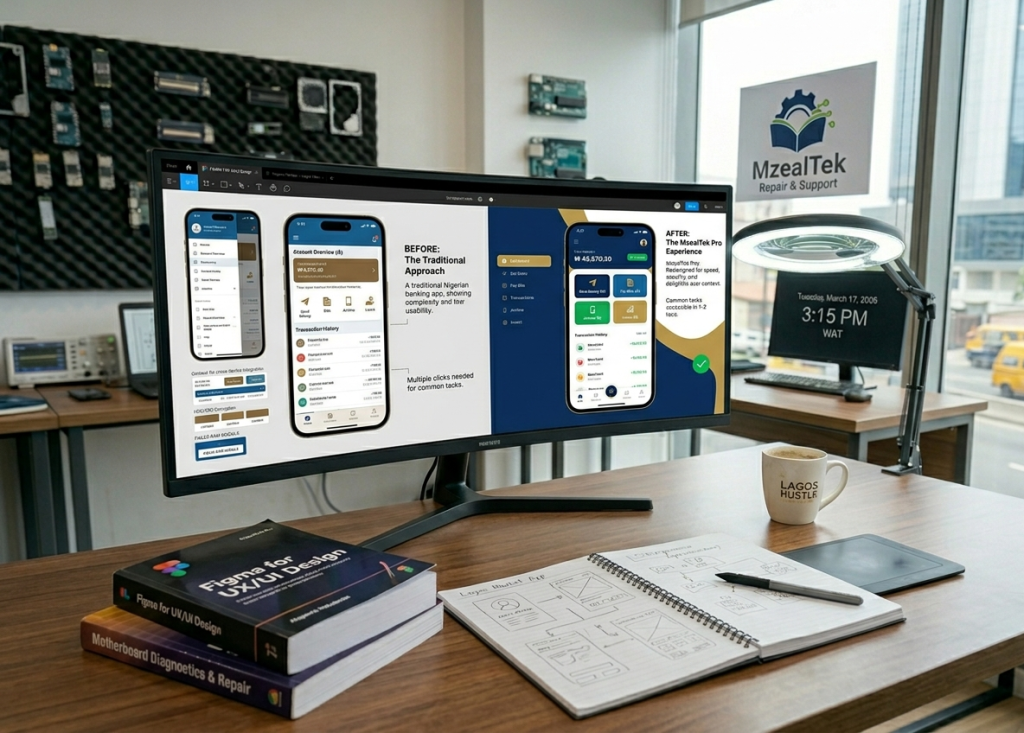
Before you open any design software, invest time in understanding design principles. Study the basics of colour theory, typography, visual hierarchy, and layout. Free resources like Google’s UX Design Certificate on Coursera (available with financial aid), YouTube channels like DesignCourse, and articles on the Nielsen Norman Group website will give you a solid theoretical footing. At this stage, you are building the “why” behind every design decision you will eventually make.
Figma is the industry standard for UI/UX design, used by teams at Google, Microsoft, Airbnb, and thousands of Nigerian startups. It is browser-based, collaborative, and, crucially, free for individual users. Start by completing Figma’s own official tutorials. Then, challenge yourself to recreate existing apps you admire: copy the layout of a popular banking app or a food delivery interface. This exercise teaches you precision and trains your eye for detail without the pressure of creating something original.
Adobe XD is another tool worth knowing, particularly if you work with clients who use the wider Adobe Creative Cloud ecosystem. However, for 2026, Figma is your priority.
Great UX design follows a structured process: Research → Define → Ideate → Prototype → Test. This is called Design Thinking, and it is the framework used by product teams at every serious tech company. Learn to conduct user interviews, create personas, build user flow diagrams, and develop wireframes. These artefacts prove to employers that you think like a designer, not just draw like one.
Free tools like Miro (for mind mapping and user flows) and Whimsical (for wireframing) are excellent at this stage.
This is the most important step and the one most beginners skip or delay. You cannot get hired without a portfolio, and you cannot build a portfolio without creating work. Start with personal projects: redesign the homepage of a local business that has a poor website. Create a concept app for a Nigerian problem you care about – perhaps a market price tracker for Lagos traders or a church management dashboard. Document your process from research through to the final design. Employers and clients care about your thinking as much as your output.
Platforms like Behance and Dribbble are the standard portfolio sites for designers. Set up your profile early and update it as you complete each project.
Once you have three to five strong case studies in your portfolio, you are ready to compete. Nigerian platforms like Jobberman and Ngcareers list entry-level design roles regularly. International freelance platforms like Upwork and Toptal open you up to global clients paying in foreign currency. In your early applications, emphasise your problem-solving process and your willingness to iterate based on feedback; these qualities matter more than years of experience to discerning employers.
At MzealTek, our UI/UX graduates receive portfolio review sessions and career coaching as part of their training. We understand that learning the skill is only half the battle; knowing how to present it to the market is the other half.

Be honest with yourself about expectations. A dedicated student who commits 2–3 hours daily can have a job-ready portfolio within 6 months. This is not a guarantee of immediate employment, but it is a realistic timeline for being competitive. The designers who succeed fastest are those who practise consistently, seek feedback actively, and never stop being curious about the products and interfaces around them.
The world is being designed, and it needs more Nigerian designers helping to shape it. Your journey can start today.